Showing posts with label Information Collection | Phase One. Show all posts

Saturday, March 24, 2012

Information Collection - 10 | An Ahmedabadi Morning

Phase One

Armed with a backpack, a camera and a motorcycle, I set out roaming around Ahmedabad to document hand painted type. I visited chief market places like Delhi Darwaza and Teen Darwaza where hand painters paint on shop boards and signage. I gathered various examples and styles of different hand painted type. My criteria was to document fancy looking Hand painted type which would have more than 1 colour or would have an interesting construction.

I found one thing to be very interesting, that the hand painted type drawn on boards was usually mono linear and not modulated like the standard script written using a kitta.

These are some of the images. The entire album can be found Here.


Information Collection - 9 | Meeting with Mr. Amit Kharsani - 2

I went to Mr. Kharsanis house, where he showed me various works of calligraphy by esteemed calligraphers like Prof. R.K. Joshi, Achyut Palav, Prof. Mohanty, where they had compiled a book called "Aksharyog".  In 1976, IDC had held a series of calligraphy workshop which Mr. Kharsani had attended. The outcome of this workshop, was compiled into a book called "Aksharyog". These are some of the works.


 You can find the rest of the album HERE

 I was keen on finding out, what is the difference between a calligrapher and a handpainter. How do calligraphers and hand painters make use of letters to form their artwork was the one question that I am studying for analysing my project.

Is the thought process calligraphers use while doing an artwork different than that of a handpainter or handpainters are just copy artists is a question to be asked !

Information Collection - 8 | Meeting with Mr. Amit Kharsani

Phase One
 
I met Mr. Amit Kharsani to ask him abut his work as a calligrapher and his views on my project. First and foremost, I told him that I was studying gujarati from the navneet book, where I had some problems regarding the construction of some key alphabets. When I pointed out, he told me that not only those, but many of the alphabets in the book had been designed improperly. He then wrote the alphabets himself, to demonstrate the actually construction of the alphabets.


I also had some discussion about the gujarati language and the script. He told me that the till a certain age, Gujarati never had a script, It was just a spoken language. People then used to write Gujarati in Devanagari using a kitta (Cut reed pen). As time progressed, Gujarati people felt the need of having their own script, thus Gujarati evolved. At first, the written Gujarati had a Shirorekha, but it soon got omitted from the script. A standard Gujarati type proportions are 6 pen strokes laid vertical, just like in Devanagari.

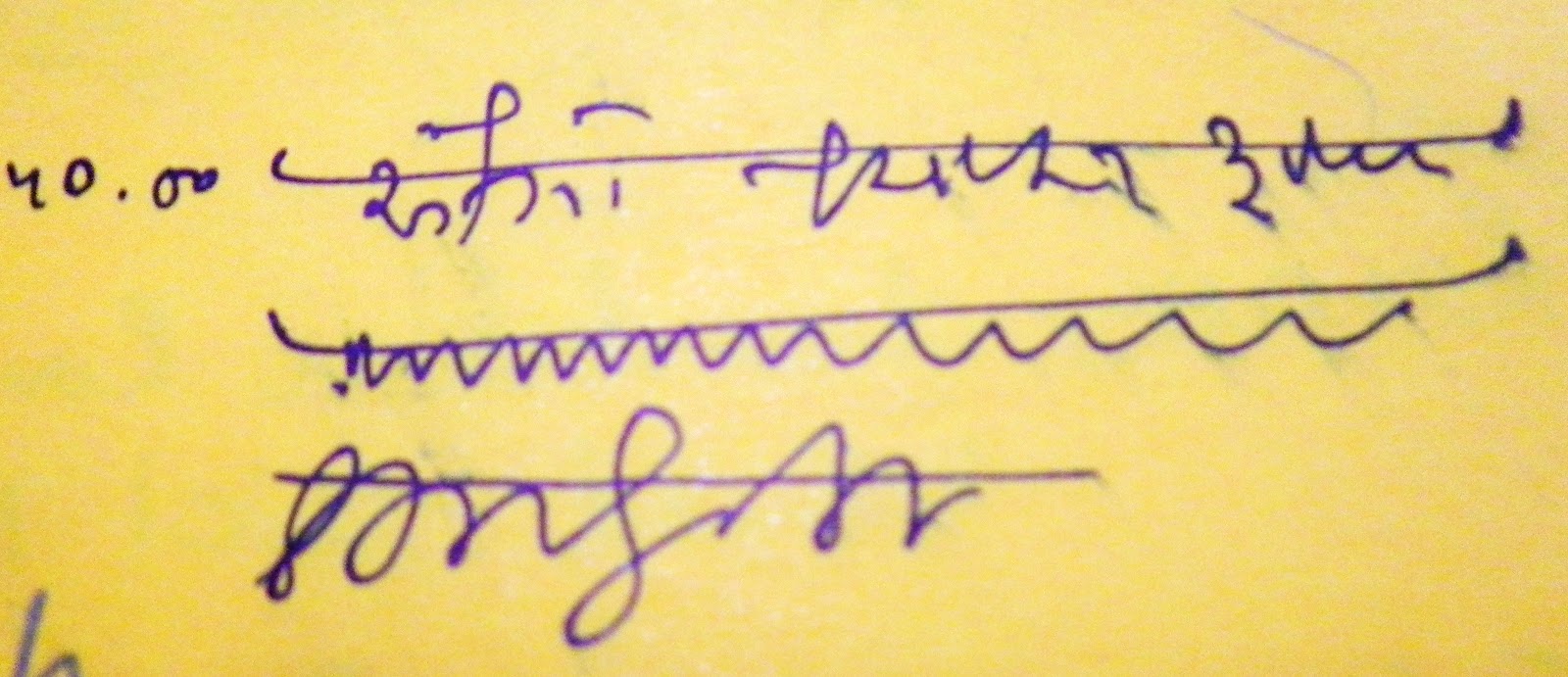
Mr. Kharsani also told that there had also been a running script in Gujarati called as Mahajani,  which was derived from the Modi lipi of ancient Maharashtra used during Shivaji's times. This script was
extensively used to write  entires in account books. This script is rarely practied today.

Mahajani as demonstrated by Mr. Kharsani


Mr. Kharsani asked me to meet him the next day, as he would bring some of his work and books to show me, so i could get more insights on my project. He asked me to look up a book called "Bhadram Bhadra" written by Kumar Shankar Joshi, which would help me in forming a sentence like "The quick brown fox jumped over the lazy dog"

Some Hand painters like Chandubhai Rana alias Painter Kaladhar at Raipur were also suggested by him who had a deep understanding of Gujarati and had been in this field for decades.

Friday, March 16, 2012

Information Collection - 7 | Exploring the Script

Phase One

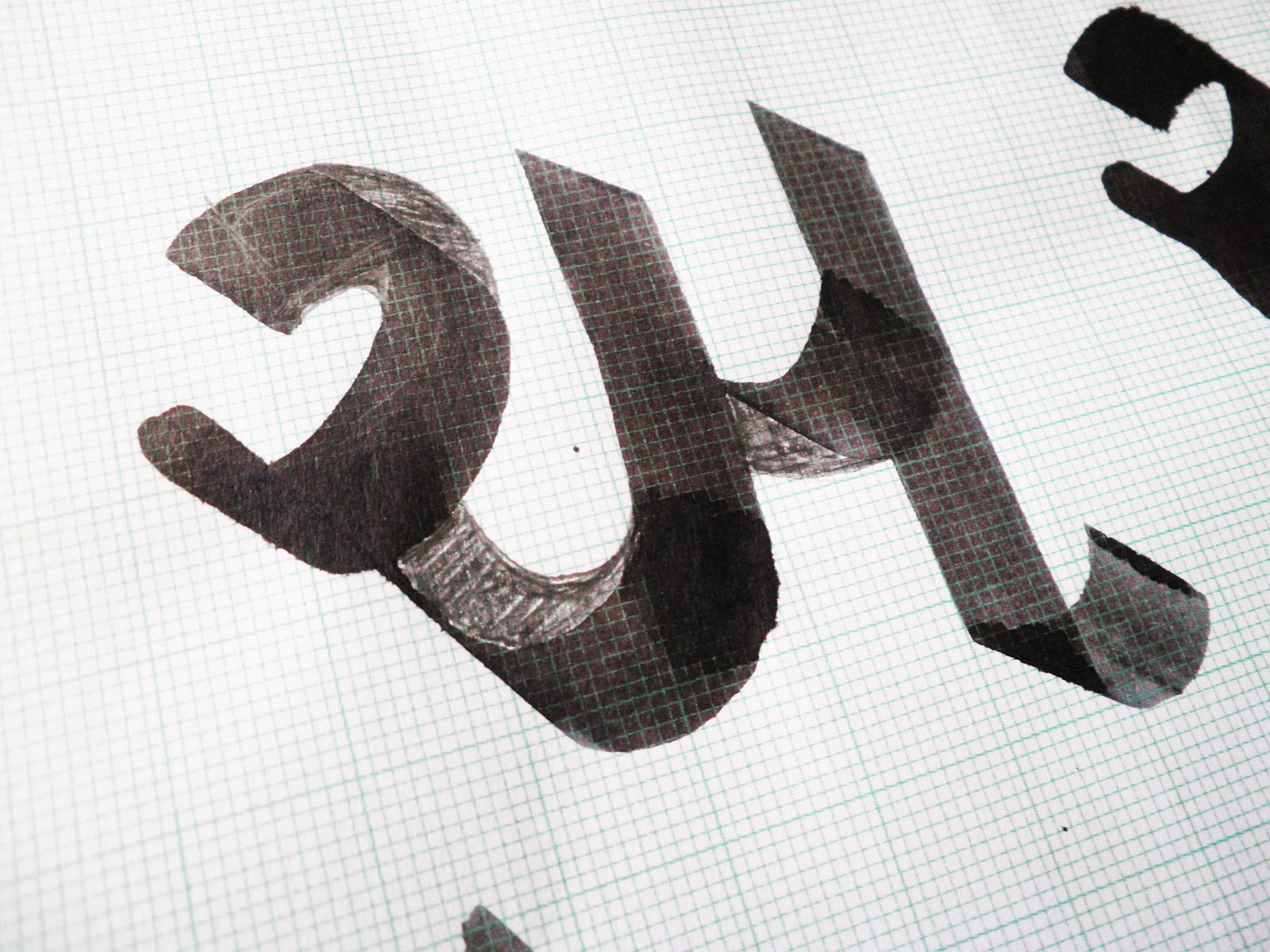
With some calligraphy tools, ink and pencil, I started exploring the script. I want to experience how handpainters feel while writing it with a brush. How forms change with diferent pressure and angle to the tools.


Information Collection - 6 | Learning to write Gujarati

Phase One 
 
I have started learning to write Gujarati by the help of Navneet's - Gujarati Varna Parichaya (Book 1). I feel this is needed, for two things. The first is to understand the letterform, its construction, its way of drawing each stroke. The second is to get well versed with the language.

I found that some characters are quite difficult to write and have unusual spacing. The "ય - ya" and the "ચ - cha", look the same, even the construction is the same, but are differencited by just a small curve while drawing the letter. Also, the "ડ - d" the written character is quite different than the character shown to write in the book.

I am now at a stage where i can read and write Gujarati.

Navneet's - Gujarati Varna Parichaya (Book One)


The letterform ક - K

The letterform ખ - kha and ગ  - g

The letterform ડ - D. Notice the difference in the writing character.


The letterform ણ - nå.

The letterform જ - gå

Tuesday, March 6, 2012

Information Collection - 4 | Something about Gujarati

Phase One
Gujarati (Gujarati(ગુજરાતી Gujarātī) is an Indo-Aryan language, and part of the greater Indo-European language family. It is derived from a language called Old Gujarati(1100 - 1500 AD) which is the ancestor language of the modern Gujarati and Rajasthani languages. It is native to the Indian state of Gujarat, and is its chief language.


There are about 65.5 million speakers of Gujarati worldwide, making it the 26th most spoken native language in the world. Gujarati is one of the twenty-two official languages and fourteen regional languages of India. It is officially recognized in the state of Gujarat, India.


The Gujarati Script

The Gujarati script (ગુજરાતી લિપિ Gujǎrātī Lipi), which like all Nāgarī writing systems is strictly speaking an abugidarather than an alphabet, is used to write the Gujarati andKutchi languages. It is a variant of Devanāgarī script differentiated by the loss of the characteristic horizontal line running above the letters and by a small number of modifications in the remaining characters.
With a few additional characters, added for this purpose, the Gujarati script is also often used to write Sanskrit and Hindi.
Gujarati numerical digits are also different from their Devanagari counterparts.

Origin
Gujarati script is descended from Brahmi and is part of the Brahmic family.The Gujarātī script was adapted from the Devanāgarī script to write the Gujarātī language. The earliest known document in the Gujarātī script is a handwritten manuscript dating from 1592, and the script first appeared in print in a 1797 advertisement. Until the 19th century it was used mainly for writing letters and keeping accounts, while the Devanāgarī script was used for literature and academic writings. It is also known as the śarāphī (banker's), vāṇiāśāī (merchant's) ormahājanī (trader's) script.

Unicode
Gujarati script was added to the Unicode Standard in October, 1991 with the release of version 1.0. Unicode block for Gujarati is U+0A80–U+0AFF. Grey areas indicate non-assigned code points.


Wednesday, February 29, 2012

Information Collection - 3 | Talk with Amélie Bonet

Phase One


Amélie Bonnet is a Type designer at Dalton Maag, London.
She had come down to NID for conducting a workshop for the PG 4th semester graphic design students. I had a very brief session about my project with her. She guided me through the type design prices she uses to make her fonts. She explained me what the Unicode system is and how I should develop my type according to it. I further asked how I can enhance this project, where she told me that I should take two hand painted type from two different designers and the see a possibility to fuse both types into one and make a completely new type.

Information Collection - 3 | Talk with Sarang Kulkarni

Phase One

I met Sarang Kulkarni on 16th February 2012. Sarang explained to me various processes involved in typed design. Firstly, he showed me a study of Painter Kafeel's type that he and Hanif Kureshi had worked out. The processes involved in making it, the visual corrections, the color variations worked out on the type, etc. were put in a form of a presentation. He then explained me the reason behind this venture. He told me that they want to promote graphic designer to use the hand painted fonts, so that the real hand painters would be benefit for it and their art would not die away. This would be done by making available the font at minimal rate, so more people can buy the font.He said that their aim was to make a good display type for the audience to use it consciously and thus making a new type awareness in India.
He discussed how a glyph set is made and advised me to work out the glyphs and the number of glyphs in my project. He also told me to make a usable font so that it can be used at a very basic level. He showed me the way how the forms of a type could be changed after getting from a hand painter. Its not that these forms are just vectorized and used, but there is a constant graphic design intervention in each form of the font.
Lastly, he told me to finalized the glyphs and get the hand painted banner form the hand painter to Mumbai the next time I come.

Monday, January 30, 2012

Information Collection - 2 | Painter + Sticker Artist + Auto Graphic Specialist

Phase One


 Painter Bobby has been practicing his art for 25years. He is passionate in making portraits of Bollywood actors and actresses. He has a fan following and renowned all over Ahmedabad for his classy graphics and bold use of color. He says he is an al router when it comes to street art. He has mastered cutting stickers of letters and doing flashy graphics with them.


Information Collection - 1 | Searching For Painters

Phase One

 On 28 January 2012, I visited Painter street on Ashram road, Ahmedabad. This street was filled with street painters painting different sizes of canvases and boards. They were mainly into Painting type, but I also saw some replicating graphics.

I met Painter Sudesh rao, who works with a bunch of other painters under him. He has been practicing this profession for around 15 years and loves colors. He says that he hasn't studied much, but he can replicate anything you give him on a canvas.

Painters on painter street charge Rs. 15 per sq. ft. for Lettering at an average. Graphics and illustrations have prices according to the content and work.


Some work of Painter Sudesh Rao.


The Painters Workspace.